
Quarky Advance Sensors Extension

Quarky Advance Sensors Extension
Extension Description
Quarky Advance Sensors extension allows users to easily work with Pulse Sensor, OLED Display, LCD, Color Sensor, Water Flow Sensor, pH Sensor, MPU6050, and ADXL345.

Introduction

The Quarky Advance Sensors Extension helps users explore real-world data using different sensors connected to Quarky. With this extension, users can read sensor values, detect environmental changes, display information on screens, and build interactive projects.

This extension is useful for creating projects related to health monitoring, color detection, motion sensing, water flow measurement, pH value reading, and display-based outputs. Users can connect sensors such as the HW827 Pulse Sensor, APDS9960 Color Sensor, MPU6050 Motion Sensor, TCS3472 RGB Sensor, Saier Water Flow Sensor, pH Sensor, OLED Display, LCD 16×2, and ADXL345 Accelerometer.

By using this extension, students learn how sensors collect data from the physical world and how PictoBlox can process and display that data through simple block coding.

Key Features:

  • Real-time heart rate monitoring
  • High-quality OLED and LCD text display
  • Color detection and proximity sensing
  • Motion, orientation, and acceleration tracking
  • pH and water flow measurement

Accessing the Quarky Advance Sensors Extension

In this section, you will add the Quarky Advance Sensors Extension to your PictoBlox project. Once added, the sensor blocks will appear in the Blocks Palette and can be used to create sensor-based projects.
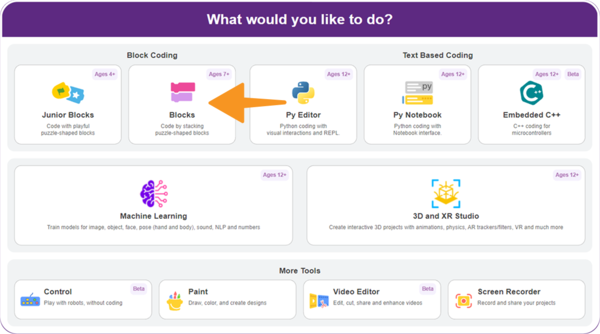
  1. Open PictoBlox and select the Block Coding environment.
    Select the Block Coding environment
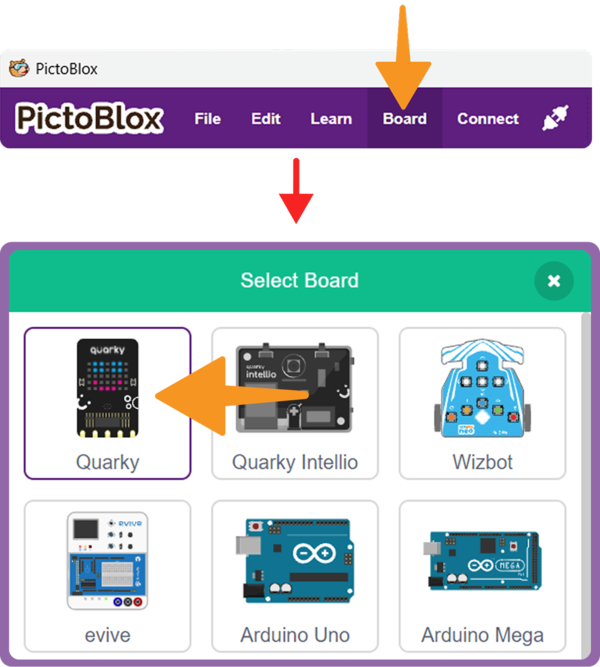
  2. Click on the Board button from the toolbar and select Quarky.Select the Quarky Board
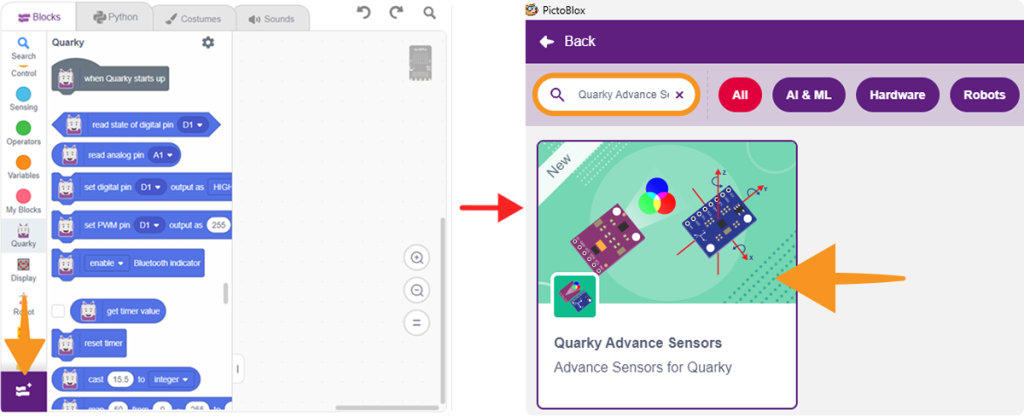
  3. Click on Add Extension from the Blocks Palette and in the search bar, type Quarky Advance Sensors.
  4. Select Quarky Advance Sensors from the extension list.
    Select Quarky Advance Sensors from the extension list
  5. The Quarky Advance Sensors blocks will now appear in the Blocks Palette.
  6. For detailed instructions on connecting your Quarky board via Serial Port (USB), please refer to the official guide: Quarky Serial Port Connection.
Read More

PictoBlox Blocks

Returns the ambient temperature measured by the BME280 sensor in degrees Celsius. The typical temperature accuracy is approximately ±0.5°C.
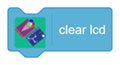
This block clears all text currently displayed on the LCD.
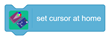
This block moves the cursor to the starting position of the LCD display.
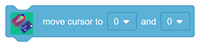
This block moves the cursor to the selected row and column position.
This block displays the entered text and blinks it at the selected time interval for the selected number of times.
This block scrolls the entered text with the selected delay.
This block displays a selected symbol, such as a heart or smiley, at the specified row and column
This block initializes the ADXL345 Accelerometer using the selected SCL pin, SDA pin, and I2C address.
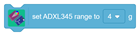
This block sets the measurement range of the accelerometer.
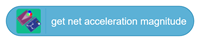
This block returns the combined acceleration magnitude calculated from all axes.
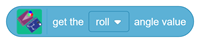
This block returns the roll or pitch angle value based on the sensor position.
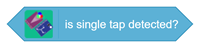
This block checks whether a single tap is detected by the ADXL345 sensor and returns true or false.
Initialises the VL53L0X time-of-flight distance sensor using I2C communication. The SDA and SCL pins must match the physical connections on Quarky. Place this block at the beginning of the program before using other VL53L0X blocks.
Returns the distance to the nearest detected surface in millimetres. The sensor measures distance using infrared laser light. The approximate measurement range is 50–1200 mm. Returns -1 if the reading times out or no valid object is detected within range.
Initialises the BME280 environmental sensor through I2C communication and performs the sensor’s internal calibration. Place this block at the beginning of the program before reading temperature, pressure, or altitude.
This block initializes the LCD using the selected SCL pin, SDA pin, and I2C address.
Returns the atmospheric pressure measured by the BME280 sensor in hectopascals (hPa). Standard atmospheric pressure at sea level is approximately 1013 hPa. Pressure readings can be used to study altitude and changes in atmospheric conditions.
Returns an estimated altitude in meters above sea level, calculated from the current atmospheric pressure. The calculation assumes a standard sea-level pressure of 1013.25 hPa. Actual readings may vary with local weather conditions.
Returns a descriptive weather condition based on pressure and humidity readings. Possible results include Sunny, Partly Cloudy, Cloudy, Rainy, Overcast, and Stormy. The block uses a simple heuristic model and should be treated as an estimate rather than a professional weather forecast.
Initialises the NEO-6M GPS module through UART serial communication. Connect the TX pin of Quarky to the RX pin of the GPS module, and the RX pin of Quarky to the TX pin of the GPS module. The module begins searching for satellites after initialisation. A cold start may take 30 seconds to several minutes to obtain a satellite fix. Keep the module in an area with a clear view of the sky.
Returns the GPS measurement selected from the dropdown menu. Available options: Latitude: Returns the current latitude in decimal degrees. Longitude: Returns the current longitude in decimal degrees. Altitude: Returns the estimated height above sea level in metres. Speed: Returns the current speed in kilometres per hour. Satellites: Returns the number of satellites currently locked. Course: Returns the heading direction in degrees, from 0° to 360°.
Returns the current time or date obtained from the GPS module. Time: Returns the time in HH:MM:SS format, such as 10:30:05. Date: Returns the date in DD/MM/YY format, such as 27/07/26. GPS time is provided in UTC and is not automatically adjusted to the local time zone.
Returns the current GPS location as a formatted text string containing latitude and longitude. For example, the output may be 22.307200 N, 73.181200 E. If the GPS module has not obtained a satellite fix, the block returns No Fix. This block is useful for displaying location on an OLED or LCD.
Initialises the INA219 current and power monitoring sensor through I2C communication. The sensor checks I2C address 0x40 first and falls back to 0x41 if necessary. It also calibrates the sensor for an expected maximum current of 400 mA with a 0.1 Ω shunt resistor, as specified in the supplied configuration.
Returns the electrical measurement selected from the dropdown menu. Available options: Bus Voltage: Returns the load voltage in volts. Current: Returns the current flowing through the shunt resistor in milliamps. Power: Returns the calculated power consumed by the load in milliwatts. Shunt Voltage: Returns the voltage drop across the shunt resistor in millivolts.
Recalibrates the INA219 sensor for a different maximum expected current without reinitialising it. Available ranges: 0.4 A: Up to 400 mA, with the highest accuracy for this configuration. 1.0 A: Up to 1 A. 2.0 A: Up to 2 A. 3.2 A: Up to 3.2 A. Use this block when the expected current exceeds the current calibration range. Ensure the selected range is appropriate for the sensor hardware and circuit.
Initialises the YDLIDAR X2 laser scanner through UART communication using the specified RX pin. Connect the LiDAR TX pin to Quarky’s RX pin; a Quarky TX connection is not required for receiving scan data. Connect the LiDAR M_CTRL pin to 3.3 V to keep the scanning motor running continuously. Allow approximately three seconds for the motor to spin up before reading distance data. This block is available in Upload Mode only.
Returns the distance to the nearest detected object in the selected direction, measured in millimetres. The block measures within approximately ±8° of the selected angle. Available directions: Front: 0° Front-right: 45° Right: 90° Back-right: 135° Back: 180° Back-left: 225° Left: 270° Front-left: 315° Returns -1 if no valid object is detected in the selected direction.
Performs a 360-degree scan and returns the distance to the nearest detected obstacle in millimetres, regardless of its direction. Returns -1 if no valid scan data is received.
All articles loaded
No more articles to load
Table of Contents